

The future of enterprise is waiting to be shifted towards environmentally friendly technologies, connected needs, autonomous and personalized commutes methods. It is a fact that the future of mobility will entirely depend upon 3 key factors – such as: digitalization of services, connected & autonomous vehicles and mobility-as-a-service.
Apart from this, enterprise mobility can effectively empower employees to do their jobs remotely without facing any complex challenges. Now, companies are focusing on enhancing their mobility functions due to the increasing trend for remote working opportunities.
5 Best Enterprise Mobility Trends
The enterprise mobility trends for the year 2023 are developing and companies are actively looking for new devices to increase remote productivity for their employees.

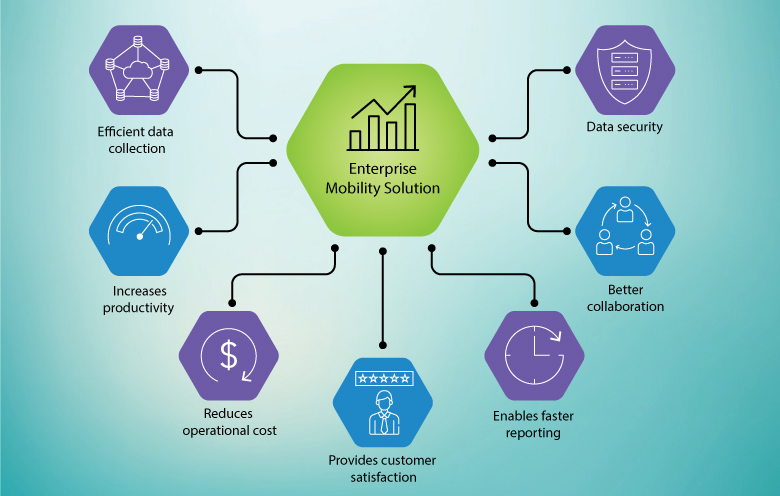
Image Credit: Softweb Solutions
#1: Trend – Bring Your Own Device (BYOD):
To reduce the asset allocation cost, companies are actively allowing their employees to utilize their own devices in the workplace. However, to conquer the negative impact of BYOD (such as: chances for data breaches, lack of firewall breach and data threats) companies are adopting enterprise mobility management systems.
The use of enterprise mobility management systems increases the efficiency level of employees. Employees who are working remotely can effectively take advantage of different mobility systems for handling the working process at remote locations.
The BYOD solutions also help the company to reduce its asset allocation cost by 20%. Policies on BYOD management also help companies to design distinguished management programs for handling remote employees.
#2: Internet of Things (IoT)
Enterprise mobility services incorporate the use of IoTs for keeping track of devices and their usage pattern effectively. In an organization, the use of IoTs helps the companies for tracking the performance of specific systems and analyze the transfer for data networks.
There are the following departments in an organization that can be connected with IoTs:
- IoT in the smart manufacturing category.
- Connected assets and preventive maintenance measures.
- Use of Smart Cities.
- Connected logistics networks.
- Smart digital supply chain networks.
- Wireless sensors.
According to the data published by Globenewswire.com, the IoT market size is expected to reach a valuation of $16.1 billion at a CAGR growth rate of 25.5% till the forecasting period of 2022 to 2028.
Apart from this, with the help of IoT sensors, companies can effectively collect data to keep a track of the performance of employees who are working remotely. It (IoT) offers real-time data about the employee’s average performance and later on, the managers can design their future strategies.
#3: 5G Networks
The future of the mobility industry effectively depends on the adoption of 5G standards and their usage in the business world. Although, 5G promises an increased data speed rate with better performance connectivity. It incorporates the potential to provide uninterrupted connections to the users.
Moreover, another key factor is based on the introduction of the Wi-Fi edition 6 network. From the organization’s perspective (Wi-Fi 6 and 5G networks) can help companies to promote higher speed of operations such as: video conferencing platforms, cloud computing systems and many more.
#4: Wearable devices
- According to the report published Markets and Marke, the global wearable technology market is expected to reach $ 265.4 billion by the year 2026.
- With the help of wearable devices, companies can keep track of the movement and recognize the patterns of their employees in an effective way.
- In an enterprise, the use of wearable devices helps companies to monitor specific performance patterns, body language and many more.
Moreover, there are the following key benefits of wearable technology in businesses – such as: it boosts employee productivity, it helps in improving communication, enhances the safety of operations and it also improves the customer service experience.
#5: AI-based chatbots

Chatbots are an important part of enterprise mobility solutions because it offers a way through which the employees, as well as customers, can get rapid answers to their questions.
The Final Words
It is recommended that IT companies should start investing in mobility-enabled solutions because it can help the companies to reduce their operational cost as well as increase employee productivity.